How to verify a news source before you trust it
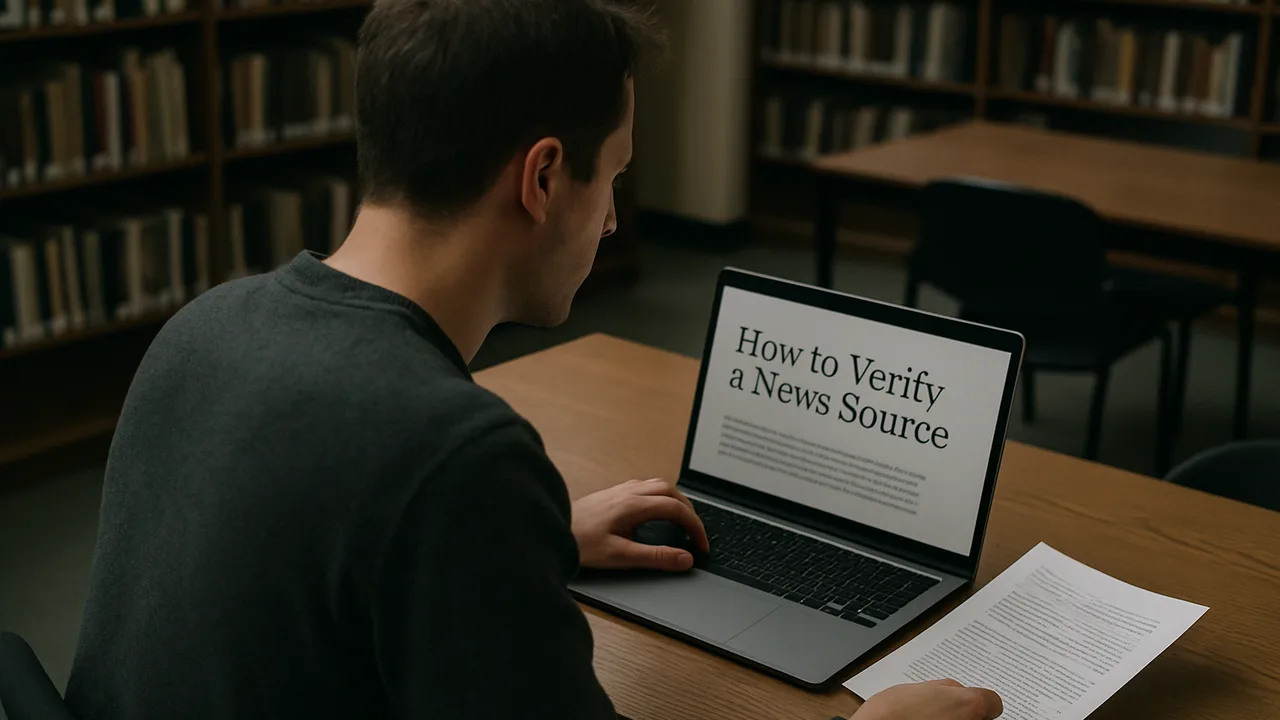
Why verifying a news source matters
Every day the average reader encounters dozens of headlines through social feeds, messaging apps, search results and email newsletters. Most of these arrive stripped of context: a screenshot without a link, a forwarded video with no date, or a bold claim quoted second-hand. Because content spreads faster than it can be checked, a single fabricated or distorted story can reach millions before anyone corrects it. Verifying a source before you trust, act on, or share it is the practical defence against that speed. Consider a concrete example: you see a post claiming a common medication has been recalled. If the claim is false and you stop taking a prescription, the consequences are real and personal. If it is true and you ignore it, that is equally serious. Verification is not about cynicism or refusing to believe anything; it is about matching your confidence to the evidence. A useful habit is to pause for roughly thirty seconds before reacting to any surprising claim and ask three questions: who is telling me this, how do they know, and can I find the same information somewhere independent? Those thirty seconds separate informed readers from those who become unwitting amplifiers. The steps below break that instinct into repeatable checks you can run in a few minutes, whether you are reading a breaking-news alert, a viral thread, or a lengthy investigative feature.
Check who owns and funds the outlet
Ownership shapes coverage, so start by identifying who stands behind a publication. Open the site's About, Masthead, or Ownership page, which reputable outlets keep easy to find. Look for the parent company, the names of editors and publishers, and any statement of funding — advertising, subscriptions, grants, or a wealthy backer. A political action committee, a trade association, or a single industry sponsor funding a supposedly neutral news site is a signal to read with extra care, because coverage may quietly favour the funder's interests. Practical steps: search the outlet's name alongside words like 'owned by' or 'funded by', and check whether a nonprofit lists its donors or an annual report. For example, a site called 'Regional Health Times' that turns out to be funded by a single supplement manufacturer should prompt caution on any article praising that manufacturer's products. Be alert to look-alike domains too. Bad actors register addresses that mimic trusted brands, swapping a letter or adding a suffix such as '.news' or '.co' to a familiar name. A common mistake is trusting a professional-looking logo; design is cheap and easily copied. If a site hides its ownership entirely, offers no physical address, and provides only a contact form, treat that opacity itself as meaningful information about how much accountability the outlet is willing to accept.
Investigate the author and their expertise
A credible article usually carries a named author, and that name should lead somewhere. Search the byline to see what else the person has written, whether they specialise in the topic, and whether other reputable outlets cite or employ them. A reporter with years covering courts brings context to a legal story that a generalist may miss. Look for a short author bio, professional credentials, and links to a verified social profile or staff page. Be cautious when articles are unsigned, credited only to 'staff' or 'admin' on a site that otherwise claims original reporting, or attributed to authors with no traceable history anywhere online. As a worked example, suppose an article about vaccine safety is written by someone described as 'Dr. J. Smith' with no institution named and no other publications: that absence is a reason to seek corroboration before trusting the conclusions. Expertise is not the same as fame; a niche academic may be far more reliable on a technical subject than a well-known commentator speaking outside their field. Watch also for the difference between a reporter and an opinion columnist — both may be skilled, but opinion pieces argue a position rather than neutrally report facts, and they should be labelled as such. When a byline is entirely absent and the story makes extraordinary claims, that combination should sharply lower your confidence until independent evidence appears.
Look for transparency in sourcing and corrections
Trustworthy journalism shows its work. Strong articles name their sources, quote documents you can inspect, link to studies or official records, and distinguish clearly between what is confirmed and what is still developing. When a report relies on anonymous sources, responsible outlets explain why anonymity was granted and describe the person's position enough to judge relevance, such as 'a senior official directly involved in the negotiations'. Vague phrases like 'sources say' or 'experts believe', with no further detail, are weaker evidence. Equally revealing is how an outlet handles mistakes. Publications committed to accuracy issue visible corrections and append update notes with timestamps rather than silently editing or deleting errors. A visible corrections policy is a sign of accountability, not weakness. As a practical test, pick one factual claim in an article — a statistic, a quote, a date — and try to trace it back to its origin. If the trail leads to a primary document, a named study, or an official statement, confidence rises. If it circles endlessly between blogs that cite each other with no original source, treat the claim as unverified. Watch for the common trap of a real study being misrepresented: an article may link to genuine research but describe its findings inaccurately, so reading the linked source's summary yourself is worth the extra minute.
Compare coverage across multiple outlets
No single outlet should be your only source for an important claim. Once you have read a story, search the core facts and see who else is reporting them. If a major event is real, multiple independent organisations with different ownership and perspectives will usually cover it within a reasonable window. When only one obscure site carries a dramatic 'exclusive' that no established newsroom mentions, that isolation is a warning rather than proof of a scoop. Cross-checking also clarifies what is fact versus interpretation. Different outlets may agree on the underlying events — a vote passed, a company reported earnings — while framing them very differently. Reading across the spectrum helps you separate the verifiable core from the spin layered on top. A practical method is to compare at least three outlets: one you already read, one generally regarded as centrist or neutral, and one from a different editorial perspective. If all three describe the same basic facts, the events are probably solid even where the commentary diverges. Pay attention to primary sources they share, such as an official transcript or a court filing, and go to that document directly when you can. A frequent mistake is treating many republications of one wire story as independent confirmation; several sites running the identical agency report is really a single source wearing different logos, so check whether the coverage is genuinely independent reporting or the same text repeated.
Use fact-checking and media-bias tools
Several established organisations specialise in verifying viral claims, debunking manipulated images, and rating the reliability of outlets. Dedicated fact-checking groups publish detailed explanations of how they reached a verdict, which is more valuable than the verdict alone because it shows the evidence. Reverse image search helps you discover whether a photo is genuinely from the event described or an old image recycled out of context — a routine tactic during breaking news. Media-literacy and bias-rating projects assess outlets for factual accuracy and lean, which is useful background, though no rating is perfect and you should read the reasoning behind any label rather than accepting a colour-coded grade at face value. To apply these tools well, use them to supplement your own reading, not replace it. For example, before sharing a shocking quote attributed to a public figure, paste it into a search engine with the person's name to see whether fact-checkers have already examined it. If an image seems too dramatic, run a reverse image search to check its true origin and date. Remember that fact-checkers cover only a fraction of everything published, so the absence of a rating does not mean a claim is true. Treat these resources as instruments that speed up verification while your own careful judgement remains the deciding factor.
Red flags that signal an unreliable source
Certain patterns reliably indicate content that deserves scepticism. Headlines written in all capitals or promising to reveal what 'they don't want you to know' are engineered for outrage rather than accuracy. Articles riddled with spelling errors, missing dates, or no author suggest little editorial oversight. Be wary of stories that ask you to share urgently before you have read them, or that demand an emotional reaction while offering no checkable evidence. A single source that claims to expose a vast conspiracy no one else reports is far more likely to be wrong than to be uniquely brave. Other warning signs include quotes with no attribution, statistics with no origin, images that appear elsewhere in unrelated contexts, and a URL that mimics a well-known brand. As a practical checklist, ask: is there a named author, a visible date, a traceable source for the main claim, and independent coverage elsewhere? If several of those are missing, hold off on trusting or sharing. A common mistake is assuming that content confirming your existing beliefs needs less scrutiny — in fact, that is exactly when a second look matters most, because agreeable claims slip past our defences. When in doubt, the safest action is to wait; a real and important story will still be there after you have taken the time to confirm it.
Example
Quick verification checklist by category
| Category | What to check | Good sign | Warning sign |
|---|---|---|---|
| Ownership | About/funding page | Named owner and clear funding | Hidden owner, no address |
| Author | Byline and history | Named expert with track record | Unsigned or untraceable name |
| Sourcing | Named sources and links | Primary documents cited | Only 'sources say' |
| Corrections | Corrections policy | Visible, timestamped updates | Silent edits or deletions |
| Coverage | Other outlets | Independent confirmation | Lone unverified 'exclusive' |
FAQ
How long should verifying a source take? A basic check often takes only a few minutes: confirm the author and date, trace the main claim to its source, and see whether other independent outlets report the same facts. Bigger or more consequential claims deserve more time and more cross-checking before you act on or share them.
Is a professional-looking website a sign of reliability? No. Polished design and a convincing logo are easy to copy and tell you little about accuracy. Focus instead on transparency of ownership, named authors, traceable sources, and a visible corrections policy, which are far harder for unreliable sites to fake.
What should I do if only one outlet reports a big story? Treat a lone report of a dramatic event with caution and wait for independent confirmation. If the claim is genuine, other credible organisations will usually cover it. Meanwhile, look for primary sources such as official statements or documents you can examine yourself.
Are media-bias ratings enough to judge a source? They are a helpful starting point but not a final answer. Read the reasoning behind any rating rather than trusting a single label, and combine it with your own checks on ownership, sourcing, and cross-outlet coverage before deciding how much to trust a story.
Read next
Read more